 Fluxtrio
Buying a used EV: checking battery health
Fluxtrio ·
What does SoH describe?
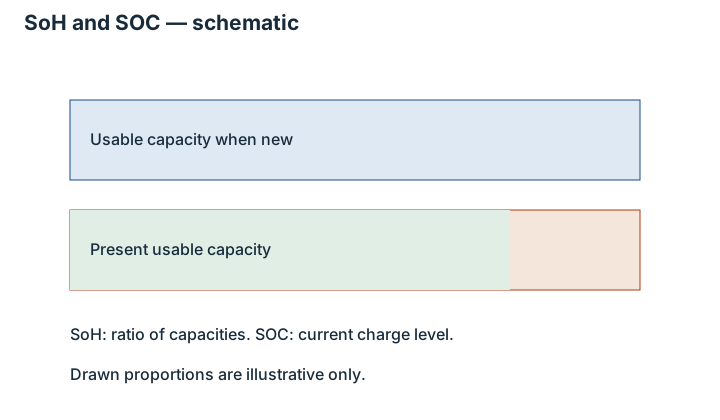
In this guide, state of health means retained usable battery capacity relative to the capacity when new. State of charge, or SOC, describes how full the battery currently is. An aged pack can still reach its present 100% charge while storing less energy than it did when new. Before buying, you therefore need the method, date and conditions behind a health percentage as well as the number itself.
A diagnostic value is not a complete inspection. It may be an estimate from the battery management system, and different methods may use different reference capacities. Ask what the report measures and which original capacity it compares against. A percentage without that explanation is a weak basis for comparing two advertisements.
A checklist before viewing the car
- Identify the exact year, battery and variant. Usable capacity is different from the gross capacity sometimes quoted in sales material.
- Request a recent health report identifying the vehicle, the test date and the method. There is no need to publish its personal information.
- Review service records for battery repairs or replacement, cooling-system work and unresolved warnings. If the pack was replaced, assess the installed battery rather than inferring its condition from the car’s age.
- Check the remaining warranty and its terms for that particular vehicle. A threshold from another manufacturer, market or model year is not interchangeable.
- Arrange an independent professional assessment if the report is unclear. Ask about the test’s limitations as well as its headline result.
During the viewing and test drive
Look for fault messages, inspect the charging connector and review the available documentation. Discuss underbody damage or suspected pack repairs with a qualified inspector; a photograph of the dashboard cannot settle those questions. A charging check can establish that a connection works, but a brief session without a known battery temperature is neither a capacity test nor proof of a charging curve.
The dashboard’s predicted distance responds to recent consumption, weather and settings. A low winter estimate alone is not evidence of degradation. Record the conditions and consumption during a test drive as context. Avoid converting one short drive directly into a precise capacity: a small SOC change, heating and display rounding can make that calculation misleading.
Use Geotab as context
Geotab’s battery-health study, already cited in our degradation guide and accessed there on 16 October 2026, gives context about ageing in the vehicles it analysed. Group results do not diagnose the car in front of you. We do not deduct the same fleet-average percentage for every year or turn it into a promised lifespan. Documented condition and suitability for your journey matter more for an individual purchase.
Keep temporary winter effects separate from lasting capacity change. Enter the measured SoH first, then change temperature independently. Treating winter range loss as both degradation and a temperature correction could count the same effect twice.
Translate health into a useful journey
Fluxtrio calculates available energy as usable capacity multiplied by SoH and the difference between departure and arrival SOC. With consumption held fixed, range changes in proportion to that energy. This isolates capacity; it does not claim that ageing can never affect other vehicle properties. The examples below use actual catalogue records, but 90% SoH and an 80→10% charge window are chosen assumptions, not measurements of those cars.
If the modelled leg falls short of a regular journey, try a lower speed or plan an energy top-up. If it only just fits, also explore headwind, rain and payload. A suitable reserve cannot be set by one universal number. The result helps you frame questions for the seller; it does not replace an inspection or verification of warranty cover.
The estimate considers the vehicle, battery health and charge, temperature, speed, driving style, payload and conditions. Cost includes charging losses and your tariff.
| Variant / source | New usable kWh | Energy at 90% SoH, 80→10% kWh | 0 °C range km: SoH 100 / 90% | Open example |
|---|---|---|---|---|
| Renault Twingo E-Tech evolution, 60 kW, 27.5 kWh, 16" (2026) | 27.5 | 17.3 | 150.2 / 135.1 | SoH 90 % |
| Volkswagen ID.7 Limited Edition, 59 kWh, 19", 5 míst, NL (2027) | 59 | 37.2 | 278.2 / 250.3 | SoH 90 % |
| Mercedes-Benz GLC Electric 400 4MATIC, 94 kWh, 21", CH (2026) | 94 | 59.2 | 368.3 / 331.5 | SoH 90 % |
Set up your journey in the calculator
- Open a specific variant in the calculator and check year, battery and standard. The preset uses 0 °C; replace it with your journey conditions.
- Set motorway speed and city share. Change one input at a time, then add occupants, luggage and weather.
- Enter documented SoH and your departure and arrival SOC. A full 100→0% window is for comparison; a journey needs a reserve.
- Enter energy price and currency and compare home and public tariffs. Save the shared link, then check the forecast and chargers before departure.
Next steps and related guides
Wheels, tyres and aerodynamics: how they affect EV range · Range methodology · EV charging curve basics · Buying a used EV: checking battery health · Home vs public charging: cost per 100 km · Winter range · Motorway speed · Heat pumps · WLTP and real range · Battery degradation · Winter charging and preconditioning
Vehicle examples from the catalogue (details in Czech): Renault Twingo E-Tech evolution, 60 kW, 27.5 kWh, 16" (2026) · Volkswagen ID.7 Limited Edition, 59 kWh, 19", 5 míst, NL (2027) · Mercedes-Benz GLC Electric 400 4MATIC, 94 kWh, 21", CH (2026). Open the calculator.
Reading population battery data
Geotab describes capacity change in observed operating cohorts; their average cannot diagnose the car you are buying. Recurrent also tracks battery replacements, a different measure from retained capacity; an individual pack needs its own documented health assessment.
Related guides
Wheels, tyres and aerodynamics · Calculation methodology · Winter range · Motorway speed
Sources & further reading
- Geotab — How long do electric car batteries last? The updated guide to real-world EV battery health (2026-04-28).
- Recurrent — New Data: How Long Do Electric Car Batteries Last? (2025-11-11).