 Fluxtrio
Home vs public charging: cost per 100 km
Fluxtrio editorial team · Prepared and reviewed 16 October 2026
Summary
Calculate charging cost using the energy you pay for and the applicable tariff. Battery energy and billed energy can differ: ADAC measured charging losses that varied with the vehicle and charging setup. A consumption figure that already includes losses must not receive a second blanket adjustment. L
Compare energy costs in Fluxtrio. Enter your own price per kWh and check the energy boundary of the consumption output before interpreting it as a bill estimate.
What information do you need?
For a useful comparison, collect your tariff, the consumption figure you intend to use and a clear description of where that energy was measured. EV Database distinguishes rated consumption, which includes charging losses, from vehicle consumption used for propulsion and on-board systems. That distinction directly affects cost arithmetic. E
Our recommendation is to label every saved scenario “battery-side” or “billed-energy”, then add the relevant tariff. If a charging offer has a subscription, time or session charge, put that term beside the energy calculation rather than silently assuming the per-kWh figure covers everything. This is a calculation checklist, not a claim about any particular charging provider.
No national average or current commercial tariff is asserted here. The prices below are deliberately invented inputs for arithmetic, so the table remains useful without presenting an unverified market survey.
How do you calculate cost per distance?
The estimate considers the vehicle, battery health and charge, temperature, speed, driving style, payload and conditions. Cost includes charging losses and your tariff.
The estimate considers the vehicle, battery health and charge, temperature, speed, driving style, payload and conditions. Cost includes charging losses and your tariff.
The estimate considers the vehicle, battery health and charge, temperature, speed, driving style, payload and conditions. Cost includes charging losses and your tariff.
This is a unit-based energy calculation. ADAC's measurements establish why energy taken from the supply can exceed energy made available for driving; EV Database's definitions establish why the starting consumption boundary must be identified. The input values below are assumptions, not measurements. L
| Illustrative scenario label | Assumed battery consumption (kWh/100 km) | Assumed price (EUR/kWh) | Derived energy (kWh/100 km) | Derived cost (EUR/100 km) |
|---|---|---|---|---|
| Home example | 18 | 0.25 | 20 | 5.00 |
| Public AC example | 18 | 0.45 | 20 | 9.00 |
| Public DC example | 18 | 0.65 | 20 | 13.00 |
The estimate considers the vehicle, battery health and charge, temperature, speed, driving style, payload and conditions. Cost includes charging losses and your tariff.
For a session estimate, use the same method with the required battery-energy increase instead of consumption per distance. Avoid multiplying a battery's gross capacity by a tariff unless that actually represents the energy purchased for the session. Fluxtrio's methodology distinguishes usable energy and the chosen charge window. M
Why charging efficiency varies
ADAC distinguishes energy taken from the supply from energy stored in the battery. Losses depend on charging power, temperature and preparation; a single coefficient cannot represent every setup. The catalogue examples below explicitly use the model assumption. L
Is a percentage loss the same percentage added to the bill?
The estimate considers the vehicle, battery health and charge, temperature, speed, driving style, payload and conditions. Cost includes charging losses and your tariff.
This is why a formula with division by efficiency is clearer than a loosely worded “add the charging loss”. It also makes it easier to see when a published consumption figure has already accounted for that energy. E
How should you interpret Fluxtrio's cost output?
The estimate considers the vehicle, battery health and charge, temperature, speed, driving style, payload and conditions. Cost includes charging losses and your tariff.
Do not add losses again to this cost output. If you make your own calculation from another consumption figure, check its energy boundary first: supply-side consumption should not receive the same correction a second time. FE
Use winter range or motorway speed to choose consumption conditions, then return to this cost calculation with your own tariff.
Methodology and limits
The ADAC table reproduces opened primary measurements with their conditions. The general illustrative table above uses manually chosen assumptions; the catalogue table below is generated from the Fluxtrio model. Neither table presents current national tariffs. DC charging has a different conversion boundary from AC, and ADAC separately measures energy used to heat or cool the battery. Do not transfer the AC table to a fast-charging session. L
This article estimates purchased energy cost. Our comparison excludes purchase price, depreciation, insurance and maintenance; it therefore makes no total-ownership-cost claim. For cold-weather charging preparation, read battery preconditioning.
Compare your own energy-price scenarios in Fluxtrio, then check the consumption boundary before treating the result as a bill estimate.
FAQ
Should I add losses to a WLTP consumption figure?
First check its definition. EV Database states that rated consumption includes charging losses, while vehicle consumption is battery-side; adding losses again would double count them. E
Are the example prices current tariffs?
No. They are explicitly assumed inputs for the worked calculation. Replace them with the terms of your own charging offer.
Did ADAC find the same loss for every wallbox setup?
No. The cited table reports different results by vehicle and charging setup under specified test conditions. L
Is Fluxtrio's documented efficiency assumption my car's measured efficiency?
The estimate considers the vehicle, battery health and charge, temperature, speed, driving style, payload and conditions. Cost includes charging losses and your tariff.
Sources
- L ADAC, Elektroauto: Wie hoch sind die Ladeverluste?, 6 August 2026; AC table, test conditions and DC section. Accessed 16 October 2026.
- E EV Database, Tesla Model 3 RWD (Highland – CATL 6L); Energy Consumption definitions. Accessed 16 October 2026.
- F Fluxtrio, calculator and cost explanation. Accessed 16 October 2026.
- M Fluxtrio, Metodika odhadu dojezdu (Czech); battery-side consumption and baseline efficiency. Accessed 16 October 2026.
Apply this to a specific vehicle
Set the conditions discussed above in the calculator. For your own comparison, use the sourced variants below (Czech); these are not claimed to match a cited test configuration: Volkswagen ID.3 Pro · Volkswagen ID.3 Pro S. Compare the full catalogue.
Home vs public charging: cost per 100 km
The estimate considers the vehicle, battery health and charge, temperature, speed, driving style, payload and conditions. Cost includes charging losses and your tariff.
The estimate considers the vehicle, battery health and charge, temperature, speed, driving style, payload and conditions. Cost includes charging losses and your tariff.
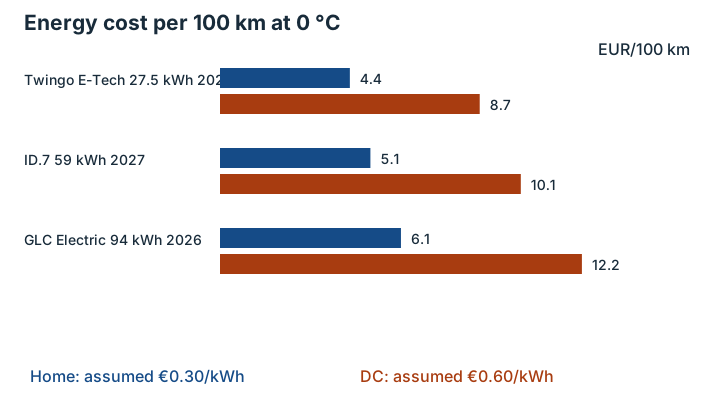
Under these assumptions DC costs twice as much for every car; that is a tariff consequence, not a property of the drivetrain. For mixed charging, weight prices by purchased energy rather than the number of sessions. Add subscriptions, session fees, time fees and parking separately. This table is not a total ownership cost calculation and cannot establish wallbox payback.
At the same energy price, consumption determines cost. Set your route and temperature before changing tariffs; a large battery does not itself reduce cost per distance. If you already have supply-side consumption, do not divide it by efficiency again. This table explicitly starts from battery-side model output and accounts for losses once.
Set up your journey in the calculator
- Open a specific variant in the calculator and check year, battery and standard. The preset uses 0 °C; replace it with your journey conditions.
- Set motorway speed and city share. Change one input at a time, then add occupants, luggage and weather.
- Enter documented SoH and your departure and arrival SOC. A full 100→0% window is for comparison; a journey needs a reserve.
- Enter energy price and currency and compare home and public tariffs. Save the shared link, then check the forecast and chargers before departure.
Next steps and related guides
Wheels, tyres and aerodynamics: how they affect EV range · Range methodology · EV charging curve basics · Buying a used EV: checking battery health · Home vs public charging: cost per 100 km · Winter range · Motorway speed · Heat pumps · WLTP and real range · Battery degradation · Winter charging and preconditioning
Vehicle examples from the catalogue (details in Czech): Renault Twingo E-Tech evolution, 60 kW, 27.5 kWh, 16" (2026) · Volkswagen ID.7 Limited Edition, 59 kWh, 19", 5 míst, NL (2027) · Mercedes-Benz GLC Electric 400 4MATIC, 94 kWh, 21", CH (2026). Open the calculator.
Related guides
Wheels, tyres and aerodynamics · Calculation methodology · Winter range · Motorway speed