 Fluxtrio
Is an EV Heat Pump Worth It? Read the Winter Evidence
Fluxtrio editorial team · Prepared and reviewed 16 October 2026
Summary
A heat pump can help preserve winter range, but the equipment label cannot tell you the whole result. Recurrent's winter study reports a 10% range benefit at 32 °F, equivalent to 0 °C, while also showing that some heat-pump-equipped cars perform poorly in its winter comparison. Treat the finding as study context, not a guaranteed upgrade for any car. R
Compare temperature scenarios in Fluxtrio. Use this to explore winter exposure; the documented calculator model does not include heat-pump equipment as an independent input. M
What does a heat pump do in an electric car?
It moves heat using refrigerant and compression, rather than supplying cabin warmth only through resistance heating. Recurrent explains that an EV's efficient drivetrain provides less waste heat for the cabin than a combustion engine, so the heating system becomes an important part of winter energy use. R
That makes the technology relevant to a range discussion, but heating efficiency and complete-vehicle range are different outcomes. Recurrent notes that heat-pump benefits diminish in very cold conditions. Its discussion also includes cars that combine a heat pump with resistance heating, so a yes/no equipment label does not fully describe the control strategy. R
Our buying recommendation is to ask how the exact car manages heat, rather than treating the presence of a heat pump as the end of the comparison. Then look for a winter test that identifies the model year and variant you might buy.
What does the study establish?
Recurrent's opened winter report analyses popular models, using data from more than 30,000 US vehicles. It reports a heat-pump benefit at freezing alongside its broader finding that analysed models retain an average 78% of ideal-condition range at 0 °C. These figures answer related but different questions: the latter describes the model set's overall winter retention. R
The report's heat-pump statement is not a percentage-point addition to every car's WLTP range. It is also not a factory option price comparison or a controlled installation experiment conducted on the buyer's exact vehicle. Read the finding alongside the report's real-world data methodology and its model-specific discussion. R
| Buyer question | Evidence available here | Sensible interpretation |
|---|---|---|
| Can heat pumps help winter range? | Recurrent reports a 10% benefit at freezing | Useful evidence for considering the feature |
| Does having one guarantee top winter performance? | Recurrent discusses weaker-performing equipped models | Compare whole vehicles and thermal strategies |
| Is the benefit constant in deeper cold? | Recurrent says benefits diminish as temperature falls | Avoid a fixed all-winter multiplier |
| Can Fluxtrio isolate the option's effect? | Its methodology excludes a separate heat-pump term | Use temperature scenarios without claiming an option-specific result |
Sources: Recurrent opening findings and heat-pump discussion R; Fluxtrio model limitations M. This is an interpretation table, not a new experiment.
Why can two equipped cars behave differently?
Recurrent discusses Cadillac Lyriq, Chevrolet Equinox EV and Blazer EV as examples with lower-than-expected winter performance despite heat-pump equipment. The authors suggest that cabin-comfort priorities and use of resistance heating may contribute. They explicitly frame that explanation as their interpretation, so it should not be presented as a manufacturer-confirmed diagnosis. R
The useful buying lesson is narrower: compare the range outcome and the cabin-heating context, rather than inferring performance from a component alone. A car is purchased as a thermal system, battery and body together; the source's observed model differences are a reason to preserve that context. R
ADAC's family-car winter test can provide an additional whole-vehicle comparison under a fixed cold motorway scenario. It was not designed as a paired heat-pump-versus-resistance-heater experiment, so its results should not be used to calculate an isolated heat-pump saving. A
How should you decide whether an option is worth buying?
We recommend starting with the problem the option would solve for you. Is the concern a recurring winter journey, frequent short departures, or reassurance when choosing a used car? Write down that use before assigning a financial value to the equipment.
Then verify the exact car's specification in a dated local manufacturer document or with the seller. Do not assume a feature listed for a similar model, another market or a different trim is fitted to the car being offered. This is a purchasing checklist; no particular manufacturer's equipment availability is asserted here.
For an optional extra, compare its quoted price with a transparent personal calculation. A defensible payback estimate needs your winter distance, tariff and evidence of the energy difference for the relevant vehicle. The winter study alone does not establish those inputs, so this article does not invent a payback period. R
See charging costs and losses for a calculation method. If range is the deciding concern, compare complete winter test results in the winter test guide.
What can you learn from Fluxtrio?
You can explore how a temperature scenario changes the estimated trip range for the selected car. Fluxtrio documents temperature, usable capacity, battery state of health and the selected charge window as parts of its calculation. Its methodology explicitly says that heat pumps, chemistry and wheel dimensions do not enter the formula independently. F
Our recommendation is to keep the same car, speed and charge window while changing temperature. Do not rename the results “with heat pump” and “without heat pump”: that would attach an equipment comparison the model has not made. If you have independent evidence for the exact car's winter performance, read that beside the calculator output instead. M
For the causes of winter losses, read winter EV range. For preparing a charging stop, use battery preconditioning. Recurrent discusses cabin heat pumps and battery preparation separately; having a heat pump does not itself establish how a car prepares for fast charging. R
Methodology and limits
This article uses Recurrent's currently opened winter report and ADAC's documented whole-vehicle test. It does not recycle older heat-pump subgroup percentages quoted in the strategy study, because the matching historical primary source was not verified. No fixed-temperature cutoff or option-specific range gain is inferred beyond the opened report. R
The practical conclusion is conditional: heat-pump evidence belongs in a winter buying decision, alongside exact specification and relevant vehicle results. It cannot replace those checks.
Explore your winter temperature scenario in Fluxtrio, keeping the documented heat-pump limitation in mind.
FAQ
Does a heat pump improve winter range?
Recurrent reports a 10% range benefit at freezing in its study context. That is not a guaranteed gain for every vehicle or journey. R
Does the benefit stay the same in extreme cold?
Recurrent says heat-pump benefits diminish as temperatures fall. This article does not assign a universal cutoff temperature. R
Can I switch heat-pump equipment on and off in Fluxtrio's documented model?
No. Its methodology says heat-pump equipment does not enter the formula independently. M
Can the study tell me an option's payback period?
No. The cited study does not establish your option price, winter mileage, tariff or the exact vehicle's energy saving. R
Sources
- R Recurrent, Best EV for Winter & Cold Weather Range, 19 November 2025; key findings, heat-pump explanation, GM discussion and About the data. Accessed 16 October 2026.
- A ADAC, Winter-Stresstest, 22 January 2026; scope and test procedure. Accessed 16 October 2026.
- F Fluxtrio, calculator and model explanation. Accessed 16 October 2026.
- M Fluxtrio, Metodika odhadu dojezdu (Czech); heat-pump limitation. Accessed 16 October 2026.
Apply this to a specific vehicle
Set the conditions discussed above in the calculator. For your own comparison, use the sourced variants below (Czech); these are not claimed to match a cited test configuration: Volkswagen ID.3 Pro · Volkswagen ID.3 Pro S. Compare the full catalogue.
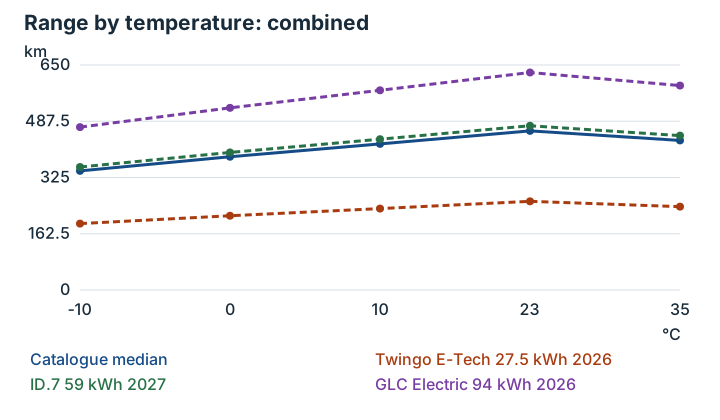
What the Fluxtrio model shows
The estimate considers the vehicle, battery health and charge, temperature, speed, driving style, payload and conditions. Cost includes charging losses and your tariff.
| °C | Median range km | Range loss %: min / median / max |
|---|---|---|
| 0 | 385 | 16.3 / 16.3 / 16.3 |
| -10 | 344.2 | 25.1 / 25.1 / 25.1 |
Loss is relative to the same variant at 23 °C. The median percentage is not a percentage calculated from median ranges.
This table describes the model’s total temperature sensitivity, not heat-pump savings. There is no heat-pump switch in the model, so it cannot produce a with/without comparison. The same car would receive the same estimate regardless of that equipment label. Assessing an option needs a comparable test with the same configuration, journey length and conditions; an equipment listing is not converted into a savings percentage.
Set up your journey in the calculator
- Open a specific variant in the calculator and check year, battery and standard. The preset uses 0 °C; replace it with your journey conditions.
- Set motorway speed and city share. Change one input at a time, then add occupants, luggage and weather.
- Enter documented SoH and your departure and arrival SOC. A full 100→0% window is for comparison; a journey needs a reserve.
- Enter energy price and currency and compare home and public tariffs. Save the shared link, then check the forecast and chargers before departure.
Next steps and related guides
Wheels, tyres and aerodynamics: how they affect EV range · Range methodology · EV charging curve basics · Buying a used EV: checking battery health · Home vs public charging: cost per 100 km · Winter range · Motorway speed · Heat pumps · WLTP and real range · Battery degradation · Winter charging and preconditioning
Vehicle examples from the catalogue (details in Czech): Renault Twingo E-Tech evolution, 60 kW, 27.5 kWh, 16" (2026) · Volkswagen ID.7 Limited Edition, 59 kWh, 19", 5 míst, NL (2027) · Mercedes-Benz GLC Electric 400 4MATIC, 94 kWh, 21", CH (2026). Open the calculator.
Related guides
Wheels, tyres and aerodynamics · Calculation methodology · Winter range · Motorway speed
Sources & further reading
- Recurrent — Best EV for Winter & Cold Weather Range (2025-11-19).
- ADAC — Winter-Stresstest: Wie reisetauglich sind E-Autos für Familien? (2026-01-22).