 Fluxtrio
Wheels, tyres and aerodynamics: how they affect EV range
Fluxtrio ·
What changes when wheels change?
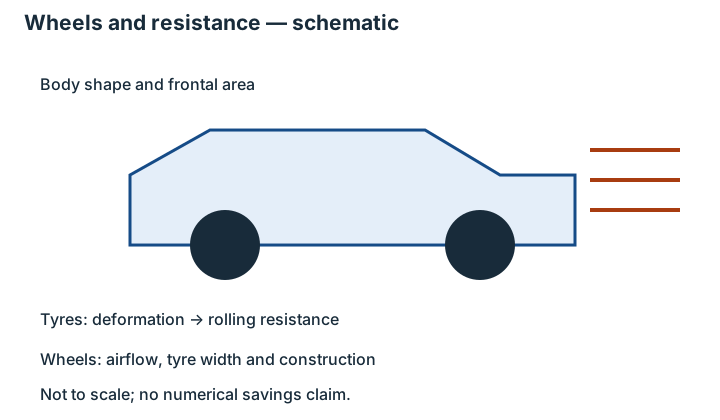
A tyre deforms as it rolls, turning some energy into heat. Rolling resistance depends on construction, compound, pressure and load; rim diameter alone cannot predict consumption. Larger rims often come with wider tyres and a different tread, but that is not an inevitable pairing.
With other factors held constant, aerodynamic drag grows approximately with the square of speed relative to the air. Frontal area and body shape also matter, including airflow around the wheels; more area or an open wheel design can increase energy demand. NASA’s explanation describes aerodynamic force rather than the car’s entire consumption.
Reading a tyre label
The EU tyre-labelling regulation distinguishes rolling-resistance classes. The efficiency class helps compare particular tyres in an appropriate size; it does not guarantee a percentage range improvement. Also check wet grip, approved dimensions, load rating and recommended cold pressure. Energy savings do not replace suitability for the conditions.
What the catalogue actually contains
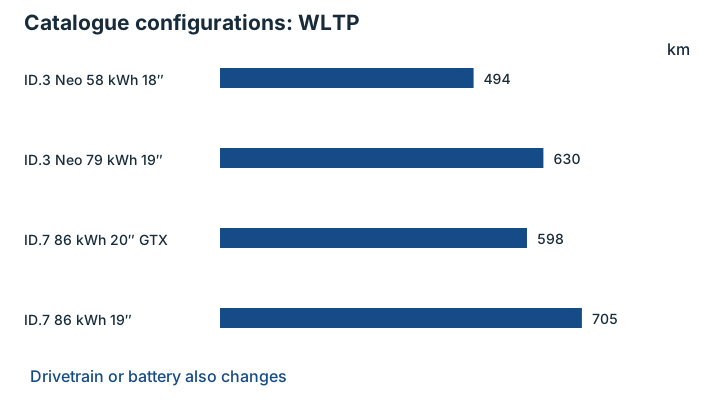
These are published configurations from VW’s Dutch-market data. The ID.7 rows have the same battery capacity but different trim and drivetrain; the ID.3 Neo rows change battery as well as wheels. Their WLTP spread cannot isolate wheel size or establish a universal penalty.
| Configuration / source | kWh | Wheels | WLTP km |
|---|---|---|---|
| Volkswagen ID.3 Neo Life, 58 kWh, 18", 5 míst, NL (2027) · VW data | 58 | 18″ | 494 |
| Volkswagen ID.3 Neo Life, 79 kWh, 19", 5 míst, NL (2027) · VW data | 79 | 19″ | 630 |
| Volkswagen ID.7 GTX Limited Edition, 86 kWh, 20", 5 míst, NL (2027) · VW data | 86 | 20″ | 598 |
| Volkswagen ID.7 Limited Edition Plus, 86 kWh, 19", 5 míst, NL (2027) · VW data | 86 | 19″ | 705 |
What tests can tell us
InsideEVs reports WLTP figures of 462 km on 19″ wheels and 431 km on 20″ wheels for the Ioniq 5 of that period. This is a different vehicle and an older certification, not a recalculation of our catalogue. BMWBlog’s report on Nyland’s iX3 gives 749 km on 20″ wheels versus an earlier 724 km on 21″ wheels. The tyre model changed too, so diameter alone cannot explain the difference.
Enhanced Auto reports approximately 3.9% lower consumption on 18″ versus 20″ wheels at 110 km/h, 2.4% at 120 km/h and 1.3% at 130 km/h. The publisher sells Tesla accessories; these are single runs with extrapolated ranges. Tyre models changed, and the 20″ baseline appears reused from another day at approximately 30 °C, while the 18″ runs were at 18–20 °C. Treat the difference at most as an indicative upper bound rather than an isolated wheel effect or guaranteed saving.
Its winter-versus-summer tyre comparison reports 186.4 versus 164.1 Wh/km. Outside temperature is missing and SOC windows differed, mixing tyre and environmental effects. This is no reason to use tyres unsuitable for winter conditions.
What Fluxtrio does and does not model
The calculator has no input for diameter, width or rolling-resistance class. A selected variant can indirectly reflect its configuration through catalogue WLTP consumption. The model cannot calculate a wheel, cover, pressure or roof-box change, so do not apply a universal percentage from someone else’s test.
Comparing your own wheel sets
First check approved dimensions and the exact vehicle configuration. Compare labels for actual tyres rather than rim diameters alone, and choose the matching catalogue variant in the calculator. For your own comparison keep route, speed, pressure, load and weather consistent; a single run remains indicative. Keep an arrival reserve and monitor real consumption on longer journeys.
Set up your journey in the calculator
- Open a specific variant in the calculator and check year, battery and standard. The preset uses 0 °C; replace it with your journey conditions.
- Set motorway speed and city share. Change one input at a time, then add occupants, luggage and weather.
- Enter documented SoH and your departure and arrival SOC. A full 100→0% window is for comparison; a journey needs a reserve.
- Enter energy price and currency and compare home and public tariffs. Save the shared link, then check the forecast and chargers before departure.
Next steps and related guides
Wheels, tyres and aerodynamics: how they affect EV range · Range methodology · EV charging curve basics · Buying a used EV: checking battery health · Home vs public charging: cost per 100 km · Winter range · Motorway speed · Heat pumps · WLTP and real range · Battery degradation · Winter charging and preconditioning
Vehicle examples from the catalogue (details in Czech): Renault Twingo E-Tech evolution, 60 kW, 27.5 kWh, 16" (2026) · Volkswagen ID.7 Limited Edition, 59 kWh, 19", 5 míst, NL (2027) · Mercedes-Benz GLC Electric 400 4MATIC, 94 kWh, 21", CH (2026). Open the calculator.
Related guides
Wheels, tyres and aerodynamics · Calculation methodology · Winter range · Motorway speed
Sources & further reading
- NAF — Sprengkulde gav rekordavvik | NAF (2026-02-02).
- EU (copy on legislation.gov.uk) — Regulation (EU) 2020/740 - Annex I Part A (fuel efficiency classes) (2020).
- Volkswagen — Volkswagen NL current technical table, snapshot 2026-10-11, MY2027 reference.
- Volkswagen — Volkswagen NL current technical table, snapshot 2026-10-11, MY2027 reference.
- InsideEVs — Hyundai Ioniq 5 Achieves WLTP Range In Bjørn Nyland's Range Test (2021-07-31).
- BMWBlog — The BMW iX3 Beat Its Own Range Record By Dropping To Smaller Wheels (2026-09-14).
- Enhanced Auto (enhauto.com blog, author Stoyan Gyurov) — Do Smaller Wheels Add Range? | Tesla Model Y Premium Test (2026-09-30).
- Enhanced Auto (enhauto.com blog, author Stoyan Gyurov) — Winter vs Summer Tires Efficiency Test | Tesla Model Y Juniper (2026-06-10).
- The Phil Ferguson Show (YouTube, @Phil_ferg) — Range test EV 20 inch wheels to 18 inch wheels.