 Fluxtrio
Range methodology: from battery to kilometres
Fluxtrio editorial team · 2026-10-23
Summary
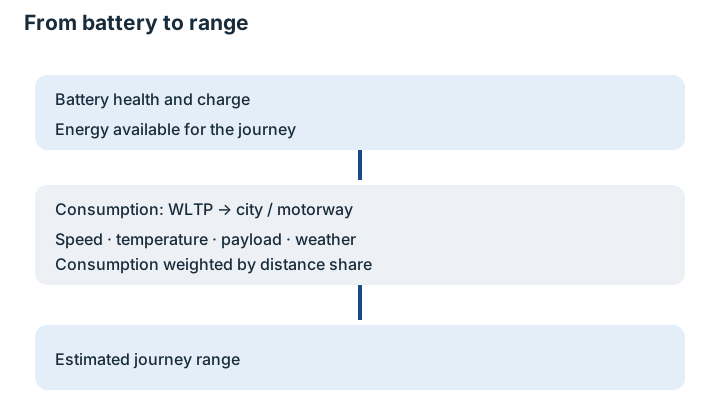
The estimate considers the vehicle, battery health and charge, temperature, speed, driving style, payload and conditions. Cost includes charging losses and your tariff.
Understanding the estimate
Choose the exact vehicle configuration and usable battery capacity. WLTP is a laboratory cycle rather than a prediction of every journey.
Enter battery health, departure charge and the arrival reserve you need. Battery ageing and your reserve affect available range.
Choose city, motorway or mixed driving to describe your trip.
Set speed and driving style. Aerodynamic drag grows roughly with the square of speed; this does not describe total vehicle consumption.
Enter temperature. Cold reduces battery efficiency and heating draws power. Air conditioning can also use energy in hot weather.
Add passengers and luggage. More mass means more rolling resistance and energy to accelerate. Regeneration recovers part of braking energy.
Consider rain, headwind and mountain roads. These are broad conditions rather than navigation or a weather forecast.
Enter your electricity tariff for cost. The estimate includes charging losses; handle parking and other fees separately.
A catalogue example
Volkswagen ID.3 Pro (2024). Temperature 0 °C, healthy battery, full charge with no arrival reserve, one occupant, normal driving style, no extra payload or adverse weather. A mix of city and motorway driving with motorway speed 110 km/h; separately, motorway-only at 130 km/h.
| Input or result | Value |
|---|---|
| Usable capacity kWh | 59 |
| Mixed consumption at 0 °C kWh/100 km | 16.088 |
| Motorway 130 consumption at 0 °C kWh/100 km | 21.6957 |
| Mixed range at 0 °C km | 366.7326 |
| Motorway 130 range at 0 °C km | 271.9429 |
Limits and sources
Results are estimates, not road tests. The model does not simulate a specific route, charging curve or individual heat pump. Keep an arrival reserve and compare matching configurations and conditions.
ADAC: Stresstest E-Autos im Winter: Wie die Reichweite auf der Autobahn ausfällt
NASA Glenn Research Center: Drag Equation | Glenn Research Center | NASA
US EPA: Testing at the National Vehicle and Fuel Emissions Laboratory
Apply this to a specific vehicle
Set the conditions discussed above in the calculator. For your own comparison, use the sourced variants below (Czech); these are not claimed to match a cited test configuration: Volkswagen ID.3 Pro · Volkswagen ID.3 Pro S. Compare the full catalogue.
Next steps and related guides
Wheels, tyres and aerodynamics: how they affect EV range · Range methodology · EV charging curve basics · Buying a used EV: checking battery health · Home vs public charging: cost per 100 km · Winter range · Motorway speed · Heat pumps · WLTP and real range · Battery degradation · Winter charging and preconditioning
Vehicle examples from the catalogue (details in Czech): Renault Twingo E-Tech evolution, 60 kW, 27.5 kWh, 16" (2026) · Volkswagen ID.7 Limited Edition, 59 kWh, 19", 5 míst, NL (2027) · Mercedes-Benz GLC Electric 400 4MATIC, 94 kWh, 21", CH (2026). Open the calculator.
Related guides
Wheels, tyres and aerodynamics · Calculation methodology · Winter range · Motorway speed
Sources & further reading
- ADAC — Winter-Stresstest: Wie reisetauglich sind E-Autos für Familien? (2026-01-22).
- NASA Glenn Research Center — Drag Equation | Glenn Research Center | NASA (2025-07-01).
- US EPA — Testing at the National Vehicle and Fuel Emissions Laboratory.