 Fluxtrio
WLTP vs Real-World EV Range: Compare the Right Numbers
Fluxtrio editorial team · Prepared and reviewed 16 October 2026
Summary
WLTP range and a winter motorway result describe different conditions. Consumption also needs a measurement boundary: rated energy use can include charging losses, while battery-side consumption excludes energy lost before storage. Compare the exact vehicle, driving conditions and energy boundary before deciding that a published figure is unrealistic. A
Build your own range scenario in Fluxtrio. Choose the matching vehicle and standard, then set temperature, road mix, battery health and the charge window you expect to use.
What is a WLTP figure useful for?
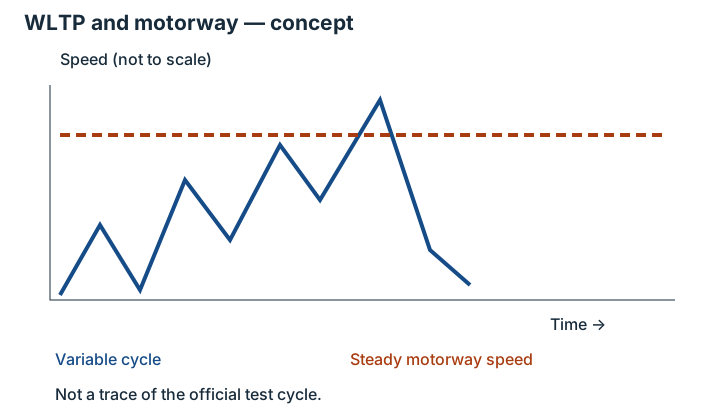
It provides a test-cycle reference, rather than a promise for every journey. ADAC's winter report explicitly contrasts the mixed driving and favourable-temperature WLTP reference with its cold motorway simulation. That explains why a different result can occur without either figure describing the other's conditions. A
Our recommendation is to use the certified figure as a starting reference and record what changes in the scenario you actually care about. For a purchasing decision, first match battery, drivetrain, model generation and the stated variant. A comparison that changes the vehicle at the same time as the test conditions cannot isolate one cause of a range difference.
| Figure | What to check | What it cannot establish by itself |
|---|---|---|
| WLTP range | Exact certified vehicle and test basis | Your winter motorway distance |
| Battery-side consumption | Energy used by propulsion and on-board systems | The complete billed charging energy |
| Rated consumption including losses | The source's charging-energy boundary | Usable battery capacity by simple multiplication |
| Estimated scenario range | Temperature, speed, heating and charge assumptions | A measured outcome for your trip |
Sources: ADAC's description of its winter comparison A; EV Database's rated/vehicle definitions and scenario notes E. The cautions follow from comparing those definitions.
Reading database estimates
EV Database separates cold, mild, city and motorway scenarios. A scenario estimate is neither certification nor a measurement of every car. E
Can you divide capacity by any published consumption figure?
Only after matching the energy boundaries. Fluxtrio documents range as usable energy divided by estimated consumption. Its methodology distinguishes battery-side table consumption from certified wall-side consumption, rather than treating the two as interchangeable. F
ID.3 Pro at 0 °C: 366.7 km; 16.1 kWh/100 km. Methodology and example.
If the consumption input instead includes charging losses, that division mixes energy supplied at the charger with energy available inside the battery. Our recommendation is to label the inputs before doing arithmetic and obtain a battery-side value or an explicitly documented conversion. EV Database's separate rated and vehicle columns illustrate this distinction. E
Does a consumption increase imply the same range loss?
No. With unchanged usable energy, range changes inversely with consumption. ADAC's winter report explains this when discussing the gap between motorway consumption and the reference figure. A
Here is illustrative arithmetic based on the same inverse relationship: if consumption rises by 50%, its multiplier is 1.5. The corresponding range multiplier is 1 / 1.5, approximately 0.667, giving about 33.3% less range. The percentage is a calculated example under fixed-energy assumptions, not a measured winter average. A
That distinction is especially useful when reading headlines. “More electricity per distance” and “less distance per charge” use different denominators. Keep the starting conditions and usable energy attached to either comparison.
What does research say about the real-world gap?
TNO's report on Dutch driving data finds an increasing difference between real-world BEV energy consumption and WLTP values over its evaluation period. The report uses charging sequences from Travelcard data and discusses the limits of deriving individual-vehicle results from them. Its conclusion concerns that fleet and period, not every driver worldwide. T
The English summary connects rising real-world energy consumption largely with increasing vehicle weight. That is useful context for interpreting a fleet trend, but it does not supply a universal correction for the model you are considering. This article deliberately avoids importing petrol or plug-in-hybrid consumption gaps as if they described battery-electric cars. T
For actual cold-weather comparisons, use the winter test guide. For speed assumptions, read motorway range.
How should you use the calculator?
Start with the standard that matches your source data, then change temperature and driving scenario. Fluxtrio exposes WLTP/EPA selection, state of health and a usable charge window in its public explanation. Its methodology says generated variant tables use full usable energy, whereas a reserve for a journey is a separate consideration. F
Our recommendation is to keep a reference calculation before changing assumptions. Do not overwrite a certified WLTP label with a scenario estimate: save both, with their definitions. For the money calculation, see charging costs and losses.
Methodology and limits
The vehicle example is an EV Database estimate, the ADAC discussion describes a controlled test, and TNO describes an observational fleet analysis. Their findings are not combined into one universal “real-world gap”. The illustrative equations use declared assumptions and do not report an executed Fluxtrio scenario. ET
No claim is made here that one certification system is universally more accurate for every journey. The practical question is whether the chosen baseline and assumptions describe the reader's intended use.
Build a trip-specific comparison in Fluxtrio, keeping the certified baseline and your scenario assumptions clearly labelled.
FAQ
Is WLTP range a winter motorway promise?
No. ADAC distinguishes the WLTP reference conditions from its cold motorway simulation. A
Does rated consumption include charging losses?
The cited EV Database page explicitly says its rated consumption includes charging losses; its vehicle-consumption column uses a different boundary. E
Can I use one correction factor for every EV?
The cited sources use different vehicles, conditions and methods. They do not establish one correction factor applicable to every EV. ET
Is a database's real-range estimate a road-test measurement?
The cited EV Database page labels its scenario ranges as indications with defined conditions. This article treats them as estimates. E
Sources
- A ADAC, E-Autos im Winter-Reichweitentest, 31 January 2025; WLTP comparison, consumption/range arithmetic and test procedure. Accessed 16 October 2026.
- E EV Database, Hyundai INSTER Standard Range; availability, Real Range, Energy Consumption and definitions. Accessed 16 October 2026.
- T TNO, Real-world fuel consumption and energy consumption of passenger cars and light commercial vehicles in the Netherlands 2024, report R10815, 29 April 2025; English summary and chapter 5, printed pages 32–34. Accessed 16 October 2026.
- F Fluxtrio, calculator and model explanation. Accessed 16 October 2026.
- M Fluxtrio, Metodika odhadu dojezdu (Czech); energy boundaries and charge-window assumptions. Accessed 16 October 2026.
Apply this to a specific vehicle
Set the conditions discussed above in the calculator. For your own comparison, use the sourced variants below (Czech); these are not claimed to match a cited test configuration: Volkswagen ID.3 Pro · Volkswagen ID.3 Pro S. Compare the full catalogue.
The estimate considers the vehicle, battery health and charge, temperature, speed, driving style, payload and conditions. Cost includes charging losses and your tariff.
Next steps and related guides
Wheels, tyres and aerodynamics: how they affect EV range · Range methodology · EV charging curve basics · Buying a used EV: checking battery health · Home vs public charging: cost per 100 km · Winter range · Motorway speed · Heat pumps · WLTP and real range · Battery degradation · Winter charging and preconditioning
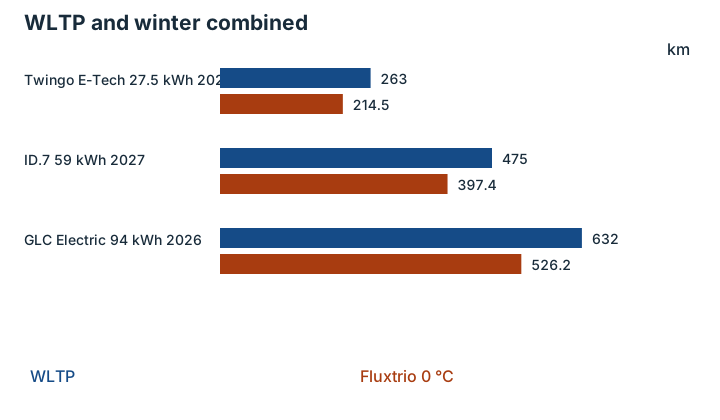
Vehicle examples from the catalogue (details in Czech): Renault Twingo E-Tech evolution, 60 kW, 27.5 kWh, 16" (2026) · Volkswagen ID.7 Limited Edition, 59 kWh, 19", 5 míst, NL (2027) · Mercedes-Benz GLC Electric 400 4MATIC, 94 kWh, 21", CH (2026). Open the calculator.
Related guides
Wheels, tyres and aerodynamics · Calculation methodology · Winter range · Motorway speed
Sources & further reading
- EV Database (ev-database.org) — EV Database - Real Range Estimation (example: Hyundai INSTER Standard Range).
- ADAC — E-Autos im Winter: Welches Elektroauto schafft die Strecke München - Berlin? (2025-01-31).
- TNO — Real-world fuel consumption and energy consumption of passenger cars and light commercial vehicles in the Netherlands 2024 (2025-04-29).