 Fluxtrio
EV Range in Winter: What Cold-Weather Studies Really Show
Fluxtrio editorial team · Prepared and reviewed 16 October 2026
Summary
An EV's winter range depends on the car and the journey. Recurrent's winter study reports average retention of 78% of ideal-condition range at 0 °C, across the models it analyses. That is a comparison with each model's favourable-weather range, rather than its WLTP rating. A winter motorway test answers a different question. R
Estimate your winter range in Fluxtrio. Select your vehicle, set the expected temperature and driving mix, then choose your intended starting charge and arrival reserve.
How much range does freezing weather take away?
Recurrent's opened report covers more than 30,000 US vehicles and analyses popular models. It combines vehicle telematics with energy-use information from on-board devices, drawing on several previous winters. Its opening findings give the freezing-temperature average above, with model results ranging from 69% to 88% retention. These are model-level findings in this dataset, not a guaranteed interval for an individual journey. R
The denominator matters. Recurrent defines ideal conditions using the maximum range observed for the particular model. Replacing that baseline with a brochure number changes the meaning of the result. It would be misleading to apply the reported retention directly to any WLTP figure without establishing that the two baselines match. R
| Evidence | Conditions or baseline | Verified finding | Appropriate use |
|---|---|---|---|
| Recurrent winter report | Freezing weather compared with each model's ideal conditions | Average retention 78% at 0 °C | Understand temperature-related variation |
| ADAC family-car test, 2026 | Simulated motorway journey at 0 °C | Audi A6 Avant e-tron performance covered 441 km | Compare cars within that test |
Sources: Recurrent opening findings and methodology R; ADAC's Audi result and test procedure A; EV Database Real Range table E. EV Database defines cold as −10 °C with heating and mild as 23 °C without air conditioning; its figures are estimates. These rows must not be averaged together. E
Why does an electric car use more energy in winter?
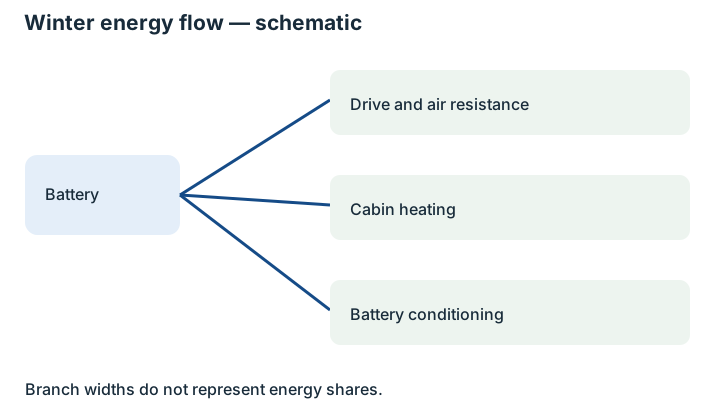
Cabin heating consumes energy that could otherwise support driving, and cold also slows processes inside the battery. Recurrent identifies heating and battery behaviour as the principal explanations in its winter report. It also explains that an efficient electric drivetrain produces less waste heat for the cabin than a combustion engine. R
That does not make cabin temperature a sensible place to compromise visibility or comfort. Our planning recommendation is to model the trip with the heating you actually need. A range estimate based on a cabin setting you will not use gives a poor basis for deciding where to stop.
The initial warm-up deserves attention. Recurrent recommends warming a plugged-in car before departure because bringing a cold car up to temperature takes more energy than maintaining warmth. This changes when and where energy is supplied; it does not make heating free. R
Why can a motorway winter test look worse?
The driving profile and the temperature act together. ADAC's family-car comparison reproduced a recorded motorway route, including elevation changes and traffic behaviour, on a laboratory test bench. The reference route averaged 111 km/h, with 130 km/h used where there was no lower limit. The chamber temperature was 0 °C. This was not a constant-speed test and did not isolate a temperature-only penalty. A
Aerodynamic drag depends on the square of air-relative speed when the other terms in the drag equation remain fixed. That physical relationship helps explain why a fast road trip requires a different scenario from urban driving. It does not establish a universal percentage reduction in total range. N
For the speed trade-off, read EV motorway range. For the comparison baseline, see WLTP versus real-world range.
How should you set up a winter trip estimate?
Start with the exact vehicle variant where available. Then set temperature, motorway share and speed. Finally, set battery state of health, meaning retained capacity relative to new, and the charge window you plan to use. Fluxtrio documents these as inputs to its usable-energy and consumption estimate. F
Keep a reference scenario with the same car and charge window at a milder temperature. Change temperature alone first; change speed separately afterwards. This is an editorial comparison method, intended to show which assumption moves the estimate. It is not an independently measured winter test.
Do not confuse a full-battery headline with the distance between charging stops. Fluxtrio's methodology says its generated variant tables use the full usable energy, while a trip reserve requires a narrower charge window. It also states that heat pumps, battery chemistry and wheel dimensions do not enter the documented formula independently. M
Is winter range loss battery degradation?
Seasonal range loss and long-term capacity loss describe different things. Recurrent says the winter effect reverses as temperatures recover. Geotab studies degradation as a change in battery capacity over time, with substantial variation between vehicles and operating conditions. A low winter dashboard estimate alone therefore does not establish permanent battery damage. R
If the concern is a used car rather than one cold journey, read battery degradation and measured SoH. For charging-stop preparation, use winter charging and preconditioning.
Methodology and limits
This article compares opened primary reports and a clearly labelled database estimate. It does not run a new vehicle test or present an executed calculator result. Recurrent's US observational dataset, ADAC's controlled motorway simulation and EV Database's scenario estimates answer different questions. Their baselines and conditions remain attached to each number. RE
Our recommendation is to use the calculator for a trip-specific comparison and then plan stops with an explicit reserve. None of these sources supplies a universal winter discount that guarantees arrival.
Set up your winter trip in Fluxtrio, with the expected temperature, motorway speed and arrival reserve.
FAQ
How much range do EVs lose at freezing?
Recurrent reports average retention of 78% at 0 °C relative to ideal conditions for the models analysed. This is not a percentage of WLTP range or an individual-trip guarantee. R
Is winter range loss permanent?
Recurrent describes seasonal winter range loss as temporary. Permanent capacity change is a separate battery-health question. R
Does a heat pump remove winter range loss?
Recurrent finds a benefit from heat pumps but also reports substantial differences between vehicles. Equipment alone does not establish a car's winter range. R
Can Fluxtrio predict my exact arrival charge?
Fluxtrio describes its output as an estimate from vehicle, weather and driving assumptions. Use it for scenario comparison and keep a trip reserve. F
Sources
- R Recurrent, Best EV for Winter & Cold Weather Range, published 19 November 2025; opening findings, heat-pump discussion and About the data. Accessed 16 October 2026.
- A ADAC, Winter-Stresstest: Wie reisetauglich sind E-Autos für Familien?, 22 January 2026; Audi result and So haben wir getestet. Accessed 16 October 2026.
- E EV Database, Tesla Model 3 RWD (Highland – CATL 6L); Real Range and scenario definitions. Accessed 16 October 2026.
- N NASA Glenn, Drag Equation, updated 1 July 2025; drag equation. Accessed 16 October 2026.
- F Fluxtrio, public calculator and explanation. Accessed 16 October 2026.
- M Fluxtrio, Metodika odhadu dojezdu (Czech); energy boundaries and model limitations. Accessed 16 October 2026.
- G Geotab, How long do electric car batteries last?, 28 April 2026; degradation definition and limitations. Accessed 16 October 2026.
Apply this to a specific vehicle
Set the conditions discussed above in the calculator. For your own comparison, use the sourced variants below (Czech); these are not claimed to match a cited test configuration: Volkswagen ID.3 Pro · Volkswagen ID.3 Pro S. Compare the full catalogue.
What the Fluxtrio model shows
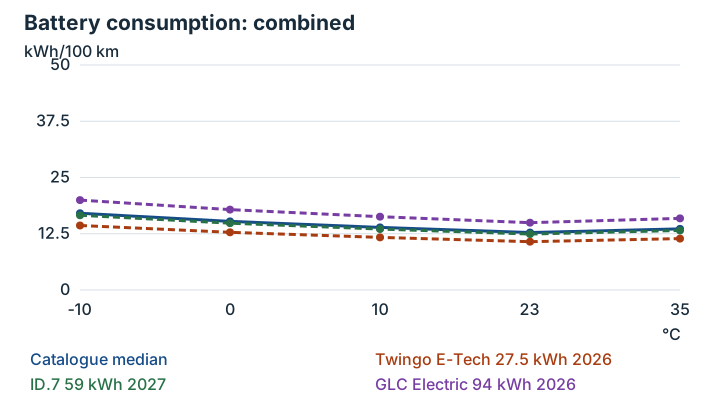
The estimate considers the vehicle, battery health and charge, temperature, speed, driving style, payload and conditions. Cost includes charging losses and your tariff.
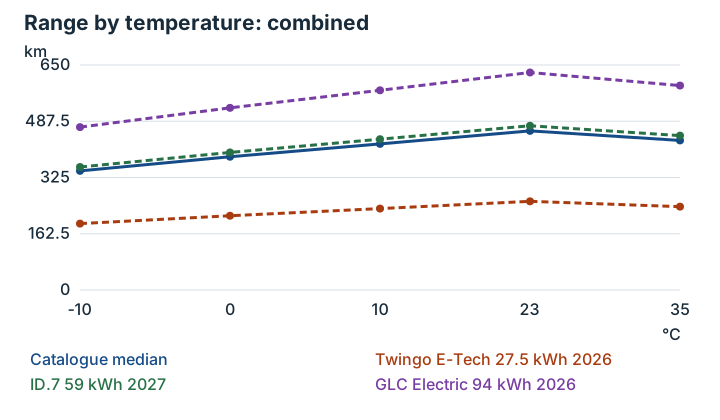
| °C | Median range km | Range loss %: min / median / max |
|---|---|---|
| 0 | 385 | 16.3 / 16.3 / 16.3 |
| -10 | 344.2 | 25.1 / 25.1 / 25.1 |
Loss is relative to the same variant at 23 °C. The median percentage is not a percentage calculated from median ranges.
The difference from mild weather or lower speed helps identify which input matters for your journey. It does not imply precision to a fraction of a kilometre. Repeated heating on short trips, the route profile and current wind can change the real result. Compare your own car with the same reserve rather than comparing someone else’s winter test with a summer catalogue figure.
Set up your journey in the calculator
- Open a specific variant in the calculator and check year, battery and standard. The preset uses 0 °C; replace it with your journey conditions.
- Set motorway speed and city share. Change one input at a time, then add occupants, luggage and weather.
- Enter documented SoH and your departure and arrival SOC. A full 100→0% window is for comparison; a journey needs a reserve.
- Enter energy price and currency and compare home and public tariffs. Save the shared link, then check the forecast and chargers before departure.
Next steps and related guides
Wheels, tyres and aerodynamics: how they affect EV range · Range methodology · EV charging curve basics · Buying a used EV: checking battery health · Home vs public charging: cost per 100 km · Winter range · Motorway speed · Heat pumps · WLTP and real range · Battery degradation · Winter charging and preconditioning
Vehicle examples from the catalogue (details in Czech): Renault Twingo E-Tech evolution, 60 kW, 27.5 kWh, 16" (2026) · Volkswagen ID.7 Limited Edition, 59 kWh, 19", 5 míst, NL (2027) · Mercedes-Benz GLC Electric 400 4MATIC, 94 kWh, 21", CH (2026). Open the calculator.
What real-world tests show
NAF / NTB’s winter 2026 El Prix report gives an average 38% range loss against WLTP at −7 to −32 °C; nine of 24 cars lost at least 40%. At −10 °C Fluxtrio calculates a median combined-range loss of 25.1% from its own 23 °C baseline. The model is less pessimistic in this comparison, but it does not cover the test’s full extreme temperature range and the baseline is not directly WLTP. This is not a measurement of model error.
Recurrent, using data from more than 30,000 US vehicles, reports average retention of 78% at 32 °F (0 °C), with models spanning 69–88%. Its baseline is the maximum observed range for each model, usually at 70–80 °F, rather than WLTP or EPA. Fluxtrio retains a median 83.7% of its own 23 °C combined range at 0 °C: more optimistic than that reported average. Shared temperature coefficients cannot represent the spread between particular heating systems.
ADAC reports average consumption 57% above WLTP at 0 °C. Its methodology replays a recorded 582 km A9 profile in a climate chamber, averaging 111 km/h with sections at 130 km/h, rather than maintaining a constant speed. At constant 130 km/h and 0 °C, Fluxtrio’s published catalogue excluding estimated inputs gives median supply consumption 61% above catalogue WLTP, a larger penalty than the test. Different vehicles, speed profiles, charging losses and sample weighting prevent direct calibration. ADAC changed its procedure from January 2026; older Ecotest results cannot be pooled directly with the new procedure.
EV Database defines estimates at −10 °C with heating, 23 °C without air conditioning and 110 km/h for motorway driving. This is an estimation methodology, not another road test or independent validation of Fluxtrio. Plan with an arrival reserve and actual journey conditions.
Related guides
Wheels, tyres and aerodynamics · Calculation methodology · Winter range · Motorway speed
Sources & further reading
- Recurrent — Best EV for Winter & Cold Weather Range (2025-11-19).
- ADAC — Winter-Stresstest: Wie reisetauglich sind E-Autos für Familien? (2026-01-22).
- EV Database — Tesla Model 3 RWD (Highland - CATL 6L) (2023-2025) price and specifications - EV Database.
- NASA Glenn Research Center — Drag Equation | Glenn Research Center | NASA (2025-07-01).
- Geotab — How long do electric car batteries last? The updated guide to real-world EV battery health (2026-04-28).
- NAF (via NTB Kommunikasjon press release) — Verdens største elbiltest: – Rekordavvik i sprengkulda (2026-01-28).
- ADAC (press release) — Audi A6 Avant e-tron performance gewinnt Winter-Reichweitentest familientauglicher E-Autos (2026-01-22).
- EV Database (ev-database.org) — EV Database - Real Range Estimation (example: Hyundai INSTER Standard Range).